01
Review platforms
Complete, current profiles where your category gets compared. When a prompt asks who's best, these are the pages the engines quote first.
RevMozi is now Blesso. Same team, same work, same contracts - new name.
AEO / GEO
Your buyer asks ChatGPT for the shortlist before they open a single vendor site. If the model doesn't know what you do, you don't make the list - and there's no page two to rank on.
Week two you get the baseline: every prompt, every engine, where you stand today.
Tracked prompts
The work
Answer engine visibility isn't a content project. It's measurement, machine-readability, published evidence, and a crawler log - and skipping any one of them stalls the other three.
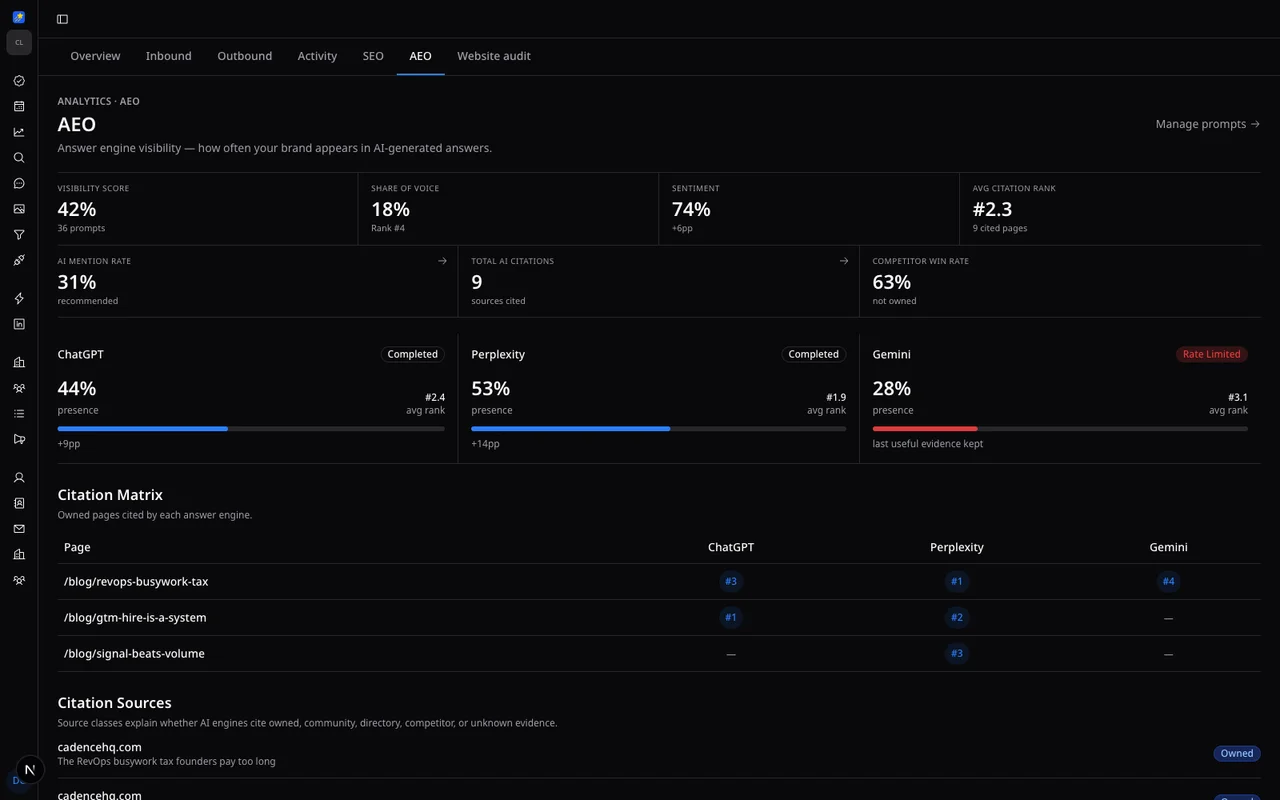
We map the prompts your buyers actually type, then run them against every engine on a schedule. You see who gets named in your category, at what rank, where the models have your story wrong - and which sources each engine trusted to build the answer, so we know whether you're losing on content, authority, or recognition.
Share of answer
Ranked against everyone else the model named
Share of answer
Ranked against everyone else the model named
What the weekly report answers
What you are choosing between
A tracker tells you which engines name you and which sources they trusted, and it is genuinely good at that. Then it hands you a login. An SEO agency ships the schema and publishes the pages, and has no notion of what an engine answered.
Blesso
Measured, fixed, published
An SEO agency
Rankings on ten blue links
An AI-visibility tracker
Measurement, then a login
Your content team
Writing, no machine layer
Measure
The prompts your buyers type
Every engine, not one
Which sources the model trusted
Fix what the models can read
Schema and structured data
llms.txt and crawler permissions
Third-party listings corrected
Earn the citation
Answer-first pages
Published under your brand
Off-site sources earned
Prove it landed
Crawler logs read
Movement traced per prompt
The split runs the same way every time: somebody measures, somebody publishes, and the work that connects the two is the work nobody sells. That gap is the next section.
Coverage
Search sent buyers ten blue links and let them choose. An answer engine names three vendors and moves on. Being cited by one and invisible in the rest is the same as being invisible - so we sweep all of them, not the one that flatters the report.
Eight surfaces, six vendors: ChatGPT, Perplexity, Claude, Copilot and Grok - plus Google three times over, because AI Overviews, AI Mode and Gemini can each name a different shortlist.
The report
Every prompt, every engine, every citation - in the same operator console that runs your outbound and your content. No screenshots pasted into a deck once a month.
The gap
There are good tools now for measuring AI visibility. They hand you a number, a prompt list, and a login - and they assume a content team on the other side to act on it. That assumption is the whole problem: the work isn't knowing you're missing from the answer, it's writing the thing that gets you into it, week after week. Measurement is where we start, not what we sell.
Prompts mapped, engines swept, gaps ranked
Schema, llms.txt, structure, crawler access
Answer pages written and shipped under your brand
Same prompts, next week, against what changed
And it runs off one queue as your organic search work, because it's the same page. A page a model will quote - direct answer up top, evidence underneath, structured so a machine can lift it - is a page that ranks. Written once, working in both places.
See the inbound motionThe line we hold
There's a whole industry seeding Reddit threads and comment farms to get named by a model. It works until the training set gets cleaned - and then it takes your brand out with it.
Seeded comments on forums and community threads
Real answers in those same threads, with your name and affiliation on them
Sockpuppet accounts arguing for your product
Real customer evidence the models can verify
Bought links and paid listicle placements
Directory and listing entries corrected to the truth
Prompt-stuffing pages written for machines to skim
Pages a buyer would want to read, structured so a model can quote them
Vanity dashboards nobody can act on
A weekly report tied to the pages and fixes it triggered
If a model names you, it's because the source was worth citing.
The sources
An unknown company describing itself is rarely the source an engine cites. Answers get composed from places the models already trust - and we build your presence there the same way we build your pages: real, verifiable, under your own name.
Complete, current profiles where your category gets compared. When a prompt asks who's best, these are the pages the engines quote first.
Industry directories and association listings, kept accurate and consistent with your site - so every source tells the same story about who you are.
Mentions and references in the publications the engines already cite - pitched with real stories and real data, never bought.
Your founder writing and answering under their own name, with consistent profiles the models can connect back to the company.
Original benchmarks and data other publishers want to reference. The fastest way to become a source is to publish something worth citing.
The threads where buyers compare vendors feed the models' memory. We answer there honestly - it's slower, which is exactly why the astroturfers fake it.
Owned pages make you clear. Outside sources make you credible.
How it runs
Prompt map
What buyers ask the engines
Visibility baseline
Where you stand on every engine
Site readability fixes
Schema, llms.txt, clean structure
Answer-ready pages
Comparisons, definitions, FAQs
Source accuracy sweep
Docs, listings, and profiles models read
Engine sweeps
Re-run prompts, log every citation
Crawler watch
Who read you, and what they took
Source authority
Reviews, directories, citable research
Weeks 1–12 shown. Ongoing workstreams continue for the life of the engagement.
This is a young channel with a lot of noise around it. Here's where we draw the lines - including the parts nobody can promise.
There's no deterministic attribution here, and nobody can hand you a clean click path from an AI answer to a signup. What we can do is triangulate - share of answer as the leading indicator, referral headers from Perplexity and ChatGPT browsing sessions, a self-reported "how did you hear about us" on your forms, and pipeline as the lagging measure. If someone promises you exact AEO attribution, they're selling you a number they made up. The weekly report puts all three tiers side by side so you can see which one moved.
Book a 30-minute call. You'll leave with a straight read on your ICP, your channels, and what 90 days of Blesso would do to your pipeline - whether or not we work together.
Reply within one business day · No deck, no pitch, just the math