One sequence, both channels.
Connection requests, messages and email are timed against each other, because two tools that cannot see one another will collide in someone's week. A reply on either channel stops both.
RevMozi is now Blesso. Same team, same work, same contracts - new name.
Outbound
Thirteen jobs sit between a TAM and a booked call - sourcing, scraping, list building, enrichment, scoring, sequencing, deliverability, replies. We run all of them and message you when something needs a yes.
Built for founders still doing sales themselves.
Blesso Four accounts ready to send.
Meridian Facilities Group
Posted two field-supervisor roles on Tuesday. The spec names the scheduling tool they are replacing.
Careers page · read Tuesday
What you are choosing between
Apollo sells the database. Clay assembles the workflow. Instantly and Smartlead send. Each is good at its slice, and the slices do not add up to a motion - somebody still has to own the other ten.
Blesso
All thirteen, operated
Apollo
Contact database
Clay
Enrichment and workflows
Instantly · Smartlead
Sending infrastructure
Source
TAM definition
TAM sourcing
Custom web scraping
List building
Qualify
Waterfall enrichment
Account scoring
Contact mapping
Signal monitoring and research
Engage
Segmentation and campaign design
Multichannel sequencing
Deliverability
Reply handling and routing
Learn
Attribution and feedback loops
An agency does cover all thirteen, which is why it is not in this table - on scope it ties. What differs there is what gets counted, and who answers when a month is quiet.
How the work is done
Each phase leaves something you can read. A TAM, a scored list, a sequence, a scorecard.
Agents pick the sources before the accounts - a licensing registry in a regulated market, job boards and changelogs in devtools. Collectors get written per campaign. Everything lands normalised to one record per domain, deduped before a cent goes anywhere near enrichment.
jobs in this phase
Before anything is sent
Personalisation that mentions someone's latest LinkedIn post is a compliment. Account research carries a reason to act instead: a problem worth solving this quarter, and the evidence for it.
Size, market, what they already run - and the disqualifiers that rule an account out before anyone spends money enriching it.
what this field produces
Fit, stated as something you could check
contact mapping
One person, two channels
Two disconnected sequences is how a prospect gets a connection request three days after replying to say no.
Connection requests, messages and email are timed against each other, because two tools that cannot see one another will collide in someone's week. A reply on either channel stops both.
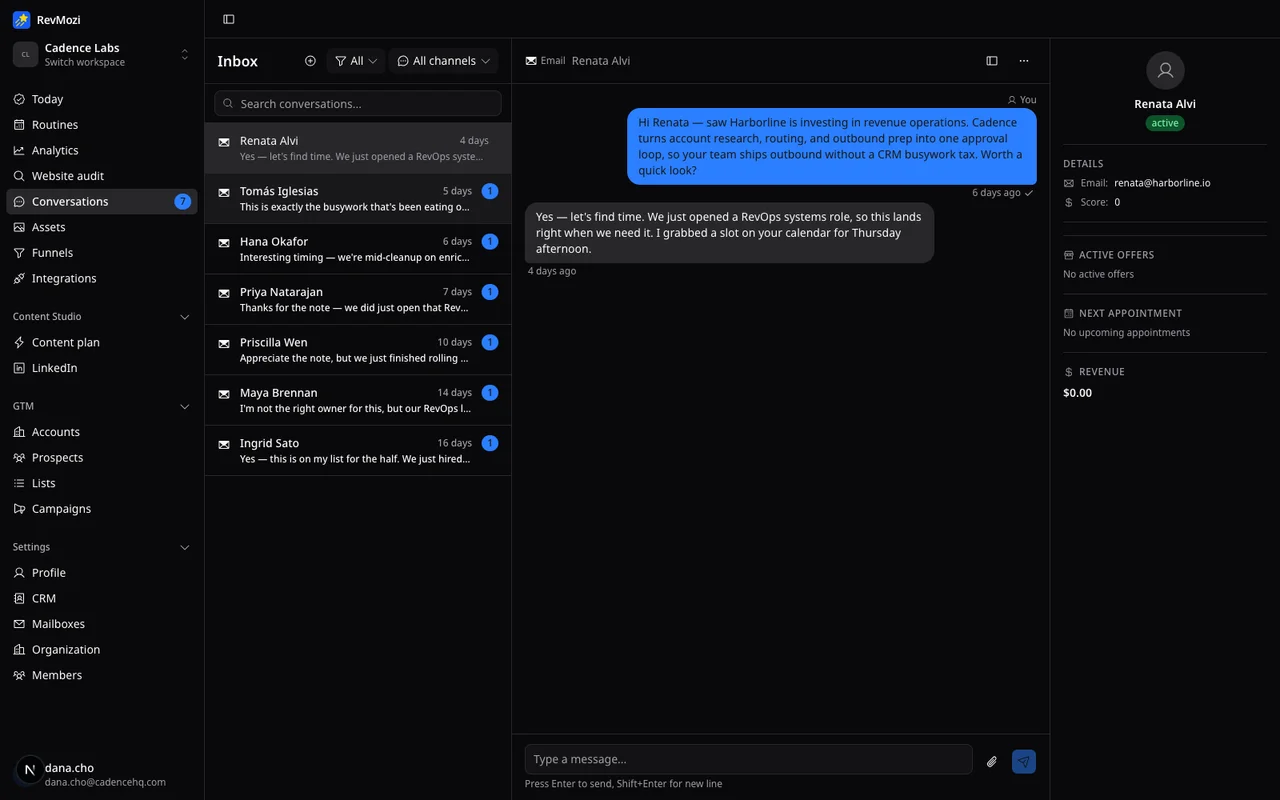
Positive, objection, referral, wrong timing, unsubscribe, out of office. Outreach pauses the moment someone engages. Real interest gets an answer the same day, or lands with you, account research attached.
Warmed domains, sender rotation, a suppression list checked before every run, bounces and unsubscribes handled, sending paced under provider limits. Every serious operator does this. Almost none say so, which is the only reason it is worth saying.
The reply inbox
The thread, the account research that produced it and a drafted next step, in one view. Approving takes about as long as reading.
How it starts
TAM definition
Segments, signals, disqualifiers
Deliverability build
Domains warmed from day one, rotation, suppression
TAM sourcing
Beyond the databases, into the sources
Custom web scraping
Collectors written per campaign, sources kept
List building and scoring
Dedupe and score before enrichment spend
Waterfall enrichment
Provider fallback order, match rate watched
Contact mapping
Three or four people per approved account
Signal monitoring and research
Why this account, why now
Multichannel sequencing
Email and LinkedIn, one sequence
Reply handling and routing
Classified, answered, booked
Attribution and feedback loops
What produced interest gets more of it
Kickoff is one or two conversations, and warm-up starts the same day because it is the one thing that cannot be hurried later. Your GTM plan comes back already drafted; the sections you skip keep our draft. Weeks 1–12 shown; the work continues for the life of the engagement.
Most people reading this have already tried an agency, an SDR, or a Clay stack they wired themselves. These are the questions that came out of that.
The work overlaps and we will not pretend otherwise: a good agency builds a list, writes the sequences and runs them. What differs is what gets counted and what gets committed. The weekly report splits into three tiers - what we sent, how the market responded, and what actually converted - with the first tier explicitly ours to answer for, and the meetings number is agreed before month one instead of discovered in month four. Agencies report the first tier and call it progress. If outbound has already cost you money once, that is usually what happened.
Book a 30-minute call. You'll leave with a straight read on your ICP, your channels, and what 90 days of Blesso would do to your pipeline - whether or not we work together.
Reply within one business day · No deck, no pitch, just the math